
Wayne Williams Atlanta Child Murders, Trial, Evidence & Mindhunter
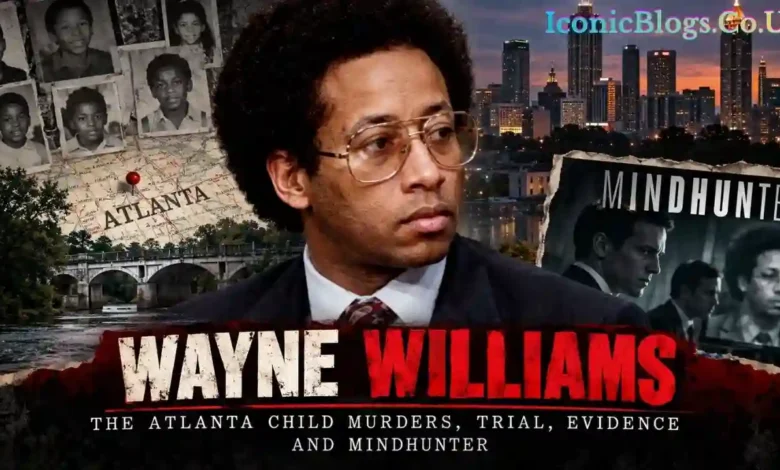
Wayne Williams is an Atlanta man who was convicted in 1982 of murdering Nathaniel Cater and Jimmy Ray Payne, two adults whose deaths were investigated as part of the wider Atlanta child murders. Authorities later attributed additional killings in the 1979–1981 Atlanta series to Williams, but he was never tried or convicted for those additional deaths. The distinction matters because the legal record and the broader investigative conclusions are not the same thing.
The case became one of the most closely watched criminal investigations in Atlanta history. Decades later, interest in Wayne Williams Atlanta continues because of unanswered questions about the victims, the forensic evidence used at trial, and how the case was presented in Netflix’s Mindhunter.
Who Was Wayne Williams?
Wayne Bertram Williams was a young Atlanta resident who worked in several media-related roles, including freelance photography and attempts to build a career in music promotion and talent management. He was 23 years old when authorities began focusing on him during the Atlanta murders investigation in 1981.
Williams grew up in Atlanta and came to the attention of investigators during a period when Black children, teenagers and young adults were disappearing or being found dead across the metropolitan area. The killings had created intense fear in the city and placed enormous pressure on law enforcement agencies to identify a suspect.
It is important to separate what Williams was convicted of from what investigators later believed. His courtroom convictions involved two murders, while law enforcement subsequently connected him to additional deaths without prosecuting him for those cases.
Wayne Williams and the Atlanta Child Murders
The Atlanta child murders generally refers to a series of killings and disappearances that occurred from 1979 through 1981. The FBI has described roughly 29 deaths during the central investigation, involving young African-American victims and creating extraordinary fear across Atlanta.
The investigation expanded into a multi-agency effort involving local and federal authorities. Investigators looked for patterns in the victims’ disappearances, locations where bodies were discovered, witness accounts and physical evidence that could connect individual cases.
A major turning point came in May 1981. Authorities had started watching bridges over the Chattahoochee River after bodies were discovered in or near the water. During a nighttime surveillance operation, investigators heard a large splash and saw a vehicle leaving the area. The driver was Wayne Williams.
At that moment, investigators did not have sufficient probable cause to arrest him. Two days later, the body of Nathaniel Cater was recovered downstream, and attention on Williams intensified.
Why the Bridge Incident Mattered
The bridge encounter did not by itself prove that Williams had committed the murders. Its importance came from the surrounding circumstances and the investigative evidence that followed.
Investigators examined Williams’s movements, statements, relationships and physical connections to the victims. The case eventually relied heavily on forensic comparisons involving fibers and hairs, together with testimony presented during the trial.
The Georgia Bureau of Investigation notes that fiber evidence played an important role in the Atlanta cases. Investigators linked green carpet fibers recovered from victims to carpet associated with Williams’s home, illustrating how trace evidence was used during the investigation.
Wayne Williams Trial and Conviction
Wayne Williams was arrested on June 21, 1981. He went on trial for the murders of Jimmy Ray Payne and Nathaniel Cater, and on February 27, 1982, a jury found him guilty of both killings. He was sentenced to two consecutive life terms.
The trial became closely associated with forensic evidence. Prosecutors presented testimony involving fibers and other physical material that they argued connected Williams to the victims. The FBI later described the convictions as resulting from meticulous hair and fiber analysis combined with witness testimony.
Williams has consistently maintained that he was innocent. Contemporary reporting after the conviction documented his continued denial, while later reporting also recorded that he was never tried for the additional child deaths attributed to him by investigators.
What Was Wayne Williams Actually Convicted Of?
| Question | Documented answer |
|---|---|
| Was Williams convicted of murder? | Yes |
| How many murder convictions? | Two |
| Who were the two victims? | Nathaniel Cater and Jimmy Ray Payne |
| Were those victims children? | No, both were adults |
| Was Williams convicted of the Atlanta child murders as a whole? | No |
| Were additional deaths attributed to him by authorities? | Yes |
| Was he tried for all of those additional deaths? | No |
This distinction is one of the most important facts to understand when researching Wayne Williams Atlanta. Describing him as having been convicted of killing all of the Atlanta child-murder victims would be inaccurate. Contemporary and later reporting consistently notes that his convictions covered two adult victims, while authorities attributed additional cases to him without separate trials.
How Many Murders Were Linked to Wayne Williams?
The exact number can vary depending on which stage of the investigation or source is being discussed. The FBI has stated that investigators concluded there was enough evidence to link Williams to 22 of the 29 deaths at the center of its account of the Atlanta investigation.
That does not mean Williams was legally convicted of 22 murders.
After the 1982 trial, authorities reviewed the remaining cases and closed numerous investigations while treating Williams as responsible. Prosecutors later decided against charging him in the additional cases because they believed the two convictions already secured life imprisonment and did not have cases they considered strong enough for another trial.
That difference between investigative attribution and criminal conviction is essential when discussing the case today.
The Evidence Against Wayne Williams
The evidence associated with the case included physical trace evidence, witness testimony and circumstances surrounding Williams’s contact with victims or locations connected to the investigation.
Fiber Evidence
Fiber evidence became one of the most discussed parts of the prosecution. Investigators compared fibers recovered from victims with materials found in Williams’s home and vehicle. The Georgia Bureau of Investigation has specifically cited the Atlanta murders as an example of a case in which fiber analysis helped establish an association.
Fiber evidence generally does not identify a person in isolation. Its significance depends on the circumstances, the nature of the material, the potential source and how the evidence fits with other investigative findings.
The Chattahoochee River Surveillance
The bridge surveillance operation provided investigators with an important break in the case. The FBI says officers heard a splash at approximately 2:52 a.m., followed a vehicle leaving the area and stopped Williams. Nathaniel Cater’s body was discovered downstream two days later.
The sequence became one of the defining moments of the investigation.
Witness Testimony and Investigative Leads
Investigators also developed witness evidence and other leads involving Williams. The case file included accounts that placed him around locations associated with some victims, although not every investigative lead resulted in a criminal charge.
Why the Wayne Williams Case Remains Controversial
The controversy comes largely from the gap between the two convictions and the much larger number of deaths eventually attributed to Williams.
Some family members and members of the Atlanta community questioned whether every case had been properly resolved after the 1982 conviction. Historical reporting shows that some people believed the investigation had moved too quickly toward a single explanation, while authorities argued that evidence connected Williams to many of the deaths.
That disagreement did not erase Williams’s murder convictions, which remained in place. In 1998, the Georgia attorney general’s office announced that a state court had denied Williams’s habeas corpus petition challenging his convictions.
The case therefore has to be viewed from two separate angles: the criminal convictions established in court and the broader investigative conclusions about other murders.
Mindhunter Wayne Williams: How the Netflix Series Tells the Story
Interest in Wayne Williams Mindhunter increased dramatically after the Atlanta murders became a major storyline in Season 2 of Netflix’s Mindhunter.
The series uses the investigation as a dramatic framework for exploring criminal profiling, law enforcement strategy and the difficulty of interpreting a complicated case. Wayne Williams appears as a central figure in the Atlanta storyline and is portrayed by actor Christopher Livingston.
For viewers searching Mindhunter Wayne Williams, it is useful to remember that the series is a dramatization rather than a courtroom transcript. Some scenes, dialogue, timelines and character interactions are presented for dramatic storytelling.
Who Played Wayne Williams in Mindhunter?
Christopher Livingston portrayed Wayne Williams in the second season of Mindhunter. His appearances are concentrated in the Atlanta storyline, where the investigation becomes one of the season’s main narrative threads.
The performance gives viewers a dramatized version of Williams’s public demeanor during the investigation, but the portrayal should not be treated as documentary evidence about his personality or motives.
Mindhunter vs. the Real Wayne Williams Case
| Real case | Mindhunter |
|---|---|
| Williams was convicted of two murders | The series makes him central to the Atlanta storyline |
| The victims in his convictions were adults | The wider case involved children, teens and young adults |
| Authorities attributed additional deaths to Williams | The show explores the uncertainty around those cases |
| The investigation involved multiple law-enforcement agencies | The series focuses heavily on FBI profiling and investigative perspectives |
| The real case unfolded over years | The show compresses events for storytelling |
The distinction matters because dramatic productions can combine historical events, real people and fictionalized scenes. Mindhunter draws heavily from the historical investigation, but it should be read as a television drama rather than a definitive account of every factual detail.
Why the Atlanta Story Reached Another Level of Scrutiny
The Wayne Williams case reached another level of public attention because the investigation involved a large number of victims, intense community fear and questions about whether one suspect could fully explain the entire series.
The issue was not simply whether Williams had been convicted. It was whether the evidence and investigative conclusions adequately addressed every case that had been grouped into the Atlanta child murders.
That distinction explains why the case has continued to attract documentaries, television programs, books and renewed public discussion decades after the original investigation.
What Happened to Wayne Williams?
Williams received two consecutive life sentences after his 1982 convictions and remained imprisoned. In November 2019, the Georgia Board of Pardons and Paroles denied another parole request, with the next consideration set for November 2027.
His continued imprisonment is tied directly to the two murder convictions that were established at trial. The additional Atlanta deaths attributed to him were not the basis for separate murder convictions.
Were the Atlanta Child Murders Ever Fully Resolved?
That question is more complicated than simply asking whether Wayne Williams was guilty or innocent.
Law enforcement agencies concluded that Williams was responsible for a substantial number of the deaths, and the FBI states that evidence linked him to 22 of the 29 deaths discussed in its case history. At the same time, he was never tried for those additional murders, leaving a legal distinction between attribution and conviction.
The case has also been revisited over the years. In 2019, Atlanta officials announced plans to re-examine evidence from the original investigations using modern technology, reflecting the continued interest in unanswered questions surrounding some of the cases.
Frequently Asked Questions About Wayne Williams
Who is Wayne Williams?
Wayne Williams is an Atlanta man who was convicted in 1982 of murdering Nathaniel Cater and Jimmy Ray Payne. Authorities later attributed additional Atlanta murder cases to him, although he was not tried for those deaths.
How many people was Wayne Williams convicted of killing?
He was convicted of two murders: Nathaniel Cater and Jimmy Ray Payne. Both victims were adults.
Was Wayne Williams convicted of killing the Atlanta children?
No. Williams was not convicted of murdering the children involved in the broader Atlanta child-murder investigation. Authorities later linked additional deaths to him, but those cases did not result in separate murder convictions.
Is Wayne Williams in Mindhunter?
Yes. Wayne Williams is a major figure in Season 2 of Netflix’s Mindhunter, where he is portrayed by Christopher Livingston. The Atlanta Child Murders form a significant part of that season’s storyline.
What evidence was used against Wayne Williams?
The prosecution used evidence including fiber and hair comparisons, witness testimony and other investigative findings. The FBI specifically describes the role of meticulous hair and fiber analysis in connecting Williams to the two murders for which he was convicted.
Final Thoughts on Wayne Williams
Wayne Williams remains closely associated with one of the most disturbing and complicated criminal investigations in Atlanta’s history. His two murder convictions are a matter of court record, while the additional killings attributed to him by authorities occupy a more complicated legal and historical space.
For anyone researching Wayne Williams, the most important takeaway is to keep those two parts of the story separate. The real investigation, the legal record and the dramatized version shown in Mindhunter overlap, but they are not identical.
Understanding that distinction makes it easier to evaluate claims about Wayne Williams, the Atlanta child murders, and Mindhunter without confusing suspicion, investigative attribution and criminal conviction. For readers exploring the case further, start with the court record and established investigative history before relying on dramatized or sensationalized retellings.
Also Read: Logan Carter: What Happened in Winsford and What the Investigation Says