

B&M Accounting Error: What Really Happened and Why It Shook Investors
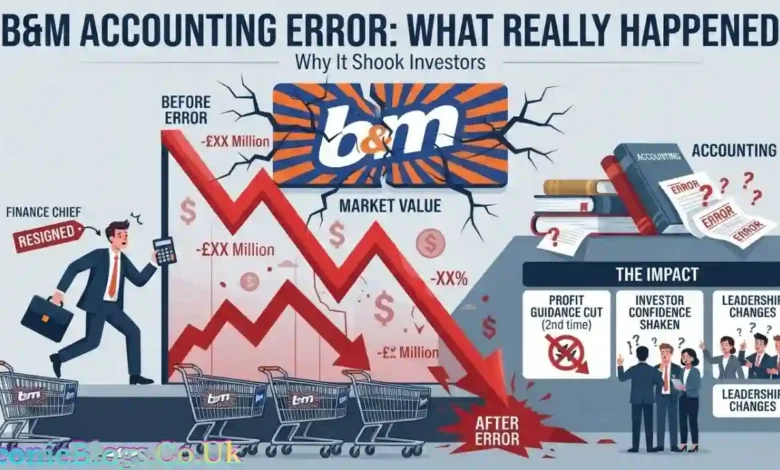
British discount retailer B&M has found itself at the centre of an uncomfortable financial storm. A costly slip-up in its books, now widely referred to as the B&M accounting error, wiped hundreds of millions off the company’s market value, cost its finance chief his job, and forced management to slash profit guidance for the second time in just a month. For a retailer known for bargain prices and no-frills efficiency, the irony of stumbling over its own numbers hasn’t escaped analysts or shareholders.
This article breaks down exactly what went wrong, how big the financial damage is, what it means for the company’s leadership, and the broader lessons every business can take from B&M’s very public misstep.
What Was the B&M Accounting Error?
At the heart of the issue is a relatively simple but costly oversight: roughly £7 million in overseas freight costs were never properly recorded in the company’s cost of goods sold. In plain terms, B&M’s finance team failed to account for shipping expenses tied to goods imported from overseas suppliers, which made the company’s reported profits look healthier than they were.
The mistake wasn’t the result of fraud or deliberate manipulation. Instead, it traces back to an operating system upgrade the company rolled out earlier in the year. Somewhere in that transition, freight cost data didn’t make its way into the new system correctly, and the gap went unnoticed until B&M’s half-year results consolidation process caught it, well after an earlier trading update had already been issued to the market.
That timing detail matters. Because the error surfaced after B&M had already published figures based on the flawed numbers, the company was forced to go back, correct the record, and explain to investors why the picture had suddenly changed.
The Financial Fallout
Once the error was identified, the numbers had to be revised, and not in B&M’s favour.
- Full-year adjusted EBITDA guidance was cut from a range of £510 million–£560 million down to £470 million–£520 million, a downgrade of roughly £40 million.
- First-half adjusted EBITDA came in around £191 million, below the previously guided figure of approximately £198 million.
- This marked B&M’s second profit warning within a single month, following an earlier downgrade linked to rising employment costs after recent tax changes affecting employers.
For a company already navigating a difficult stretch, this second hit landed particularly hard. It wasn’t just about the £7 million itself; it was what the error signalled about the reliability of B&M’s internal financial controls at a moment when investors were already watching closely.
How Investors Reacted
Markets don’t take kindly to surprises, especially ones involving the accuracy of a company’s own books. When news of the accounting error broke, B&M’s share price dropped sharply, with reports of declines ranging from around 15% to nearly 23% in a single trading session. Shares tumbled to their lowest levels in roughly nine years, erasing close to £400 million from the company’s market capitalisation in a matter of hours.
Industry commentators didn’t hold back either. Analysts described the situation as deeply embarrassing for the board, noting that while no one was accusing anyone of dishonesty, the sheer severity of the mistake made it clear something had to change at the top. The broader concern among some analysts was whether B&M might also be operating at thinner gross margins than previously assumed, adding another layer of uncertainty for anyone trying to value the stock.
Leadership Fallout: The CFO Steps Down
Perhaps the most consequential outcome of the B&M accounting error was the departure of Chief Financial Officer Mike Schmidt. Schmidt, who had held the CFO role since 2022 after a lengthy career at furniture retailer DFS and earlier stints at major investment banks, announced he would be stepping down in the wake of the disclosure.
Importantly, Schmidt wasn’t shown the door immediately. B&M confirmed he would remain in his position while a search for a successor gets underway, ensuring some continuity during the transition rather than leaving the finance function leaderless during an already turbulent period.
His exit adds to a string of leadership changes at B&M in recent times. The company’s previous chief executive stepped away earlier in the year following a separate profit warning, with a new CEO brought in to lead a turnaround. Against that backdrop, the accounting error and subsequent CFO departure feel less like an isolated incident and more like part of a wider period of instability the retailer is working to move past.
B&M’s Response and Next Steps
To its credit, B&M didn’t try to downplay the seriousness of the situation. The company confirmed that the underlying system issue behind the miscalculation had been resolved, meaning the same freight-cost gap shouldn’t recur going forward. It also announced plans to commission an independent, third-party review to dig into exactly how the error occurred and, just as importantly, why it wasn’t caught sooner.
Investors were told that a fuller update would follow alongside the company’s interim results, giving analysts and shareholders a clearer picture of both the financial impact and any additional governance changes stemming from the review.
The Bigger Lesson: Why Cost of Goods Sold Errors Matter
It’s worth stepping back to appreciate why an issue involving freight costs and cost of goods sold can cause this much disruption. COGS isn’t just an accounting line item tucked away in a footnote, it directly shapes a company’s gross margin, which in turn influences everything from investor confidence to strategic decision-making.
Get COGS wrong, even by a relatively modest amount like £7 million, and the ripple effects can be significant:
- Profitability looks distorted. Management, analysts, and investors may all be working off a skewed picture of how healthy the business actually is.
- Strategic decisions get built on shaky ground. Pricing, expansion plans, and cost-cutting measures might be based on numbers that don’t reflect reality.
- Tax calculations can be affected. Miscalculated costs can lead to miscalculated tax liabilities, creating additional financial and compliance headaches down the line.
One bookkeeping expert has gone so far as to call COGS errors among the quietest yet most damaging profit-killers a business can face, precisely because they’re not always obvious until a formal review or audit uncovers them.
What Other Businesses Can Learn From B&M’s Mistake
While few companies operate at B&M’s scale, the underlying lesson applies broadly, especially to any business going through a systems migration or software upgrade.
Key takeaways include:
- Test data migrations thoroughly. When moving to a new operating or accounting system, every cost category, including less obvious ones like freight or shipping, needs to be verified, not assumed.
- Build in redundant checks. Relying on a single system update without a secondary review process leaves room for exactly this kind of gap to slip through unnoticed.
- Choose accounting software that fits your actual operations. A system that doesn’t map cleanly to how a business tracks international costs increases the risk of errors like this one.
- Don’t wait for year-end to catch problems. Regular reconciliation, rather than discovering issues during a formal consolidation process, can prevent small errors from snowballing into public disclosures and profit warnings.
Final Thoughts
The B&M accounting error reminds us that even well-established, large-cap companies aren’t immune to basic financial control failures, especially during periods of system change. What started as a technical oversight involving overseas freight costs ended up triggering a leadership shake-up, a sharp share price decline, and a formal independent review, all within the space of a single trading update.
For B&M, the road ahead involves rebuilding investor confidence, tightening internal controls, and demonstrating through its upcoming interim results that the issue truly has been resolved. For everyone else watching from the outside, it’s a useful case study in just how much damage a seemingly small accounting gap can cause when it goes unnoticed for too long.
Also Read: Best Small Business Accounting Software: A Complete Buyer’s Guide